A few weeks ago we got the chance to travel ’round the bay to the town of Brigus, to take a look at the John Antle gravestone. This was a unique gravestone situation, the stone was sitting behind the Stone Barn Museum, where it has lived for many many years. Made from imported limestone, the Antle gravestone had broken into many pieces before it was brought to the museum’s property for safe keeping. Our client was interested in seeing if an inscription was still visible on the face of the gravestone, so we could figure out which ‘John Antle’ it was (popular name in the area in the 18th and 19th centuries!), so we gathered our cleaning supplies and headed out to Brigus (with the permission of the museum, of course)!
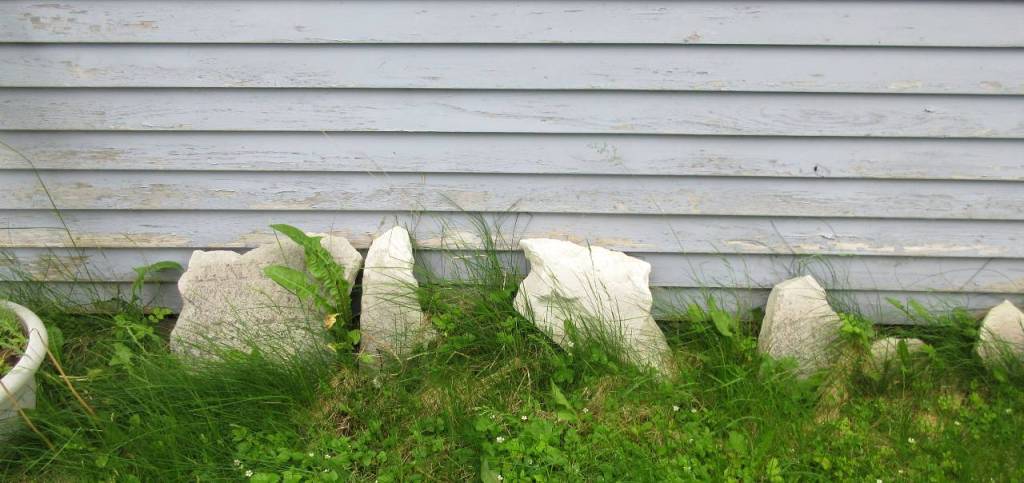
It proved to be quite the puzzle, but we were pleasantly surprised by how many pieces of the stone there actually still were present! The first step was to carefully move all the gravestones out on the lawn behind the Stone Barn museum and clean them. The stones were surprisingly clean, with just some staining along the bottom of the pieces where they were resting against the ground or moss had tried to grow on the surfaces.
Limestone has a high content of calcium, that plants really love, so it is really common to see biological growth on the surface of these stones. What happens when plants are stuck to stones is that their little roots are eating the calcium for nutrients, and by doing that they eat away some of the surface of the stone. This is mainly a problem with vines, which luckily we don’t see too much of here in Newfoundland, but can cause huge amounts of damage to the surface of gravestones. Top tip, don’t pull heavy plant growth off gravestones (or walls), but instead cut the vines at the base and wait for them to die, before scraping gently away.
Luckily the Antle stone didn’t have any of those issues, so we were able to clean it up pretty quickly. Then came the task of figuring out which pieces could fit together! At one point, we weren’t totally sure if we had only one gravestone, there were so many pieces of inscribed stone laying around! However, it did turn out that they were all part of the same gravestone, and the left picture below shows the ‘finished’ gravestone after it was puzzled back together.
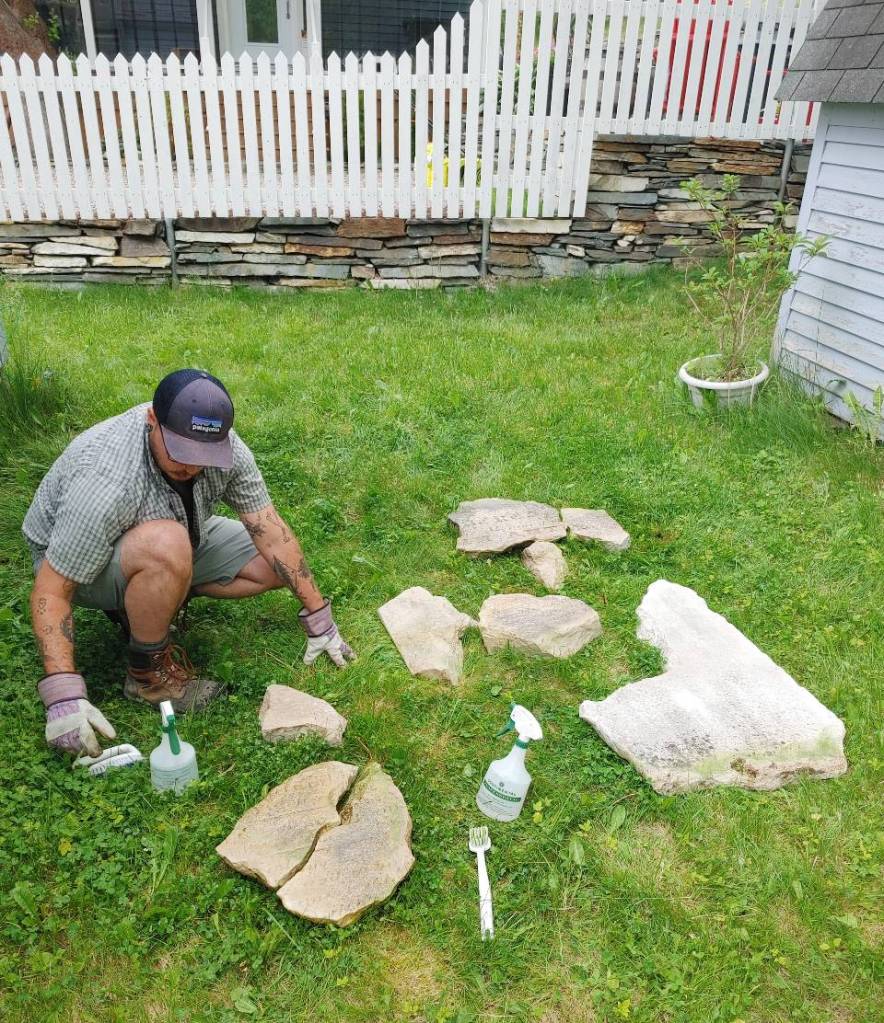
Ian working to clean the Antle stone (photo by Lacy 2021) 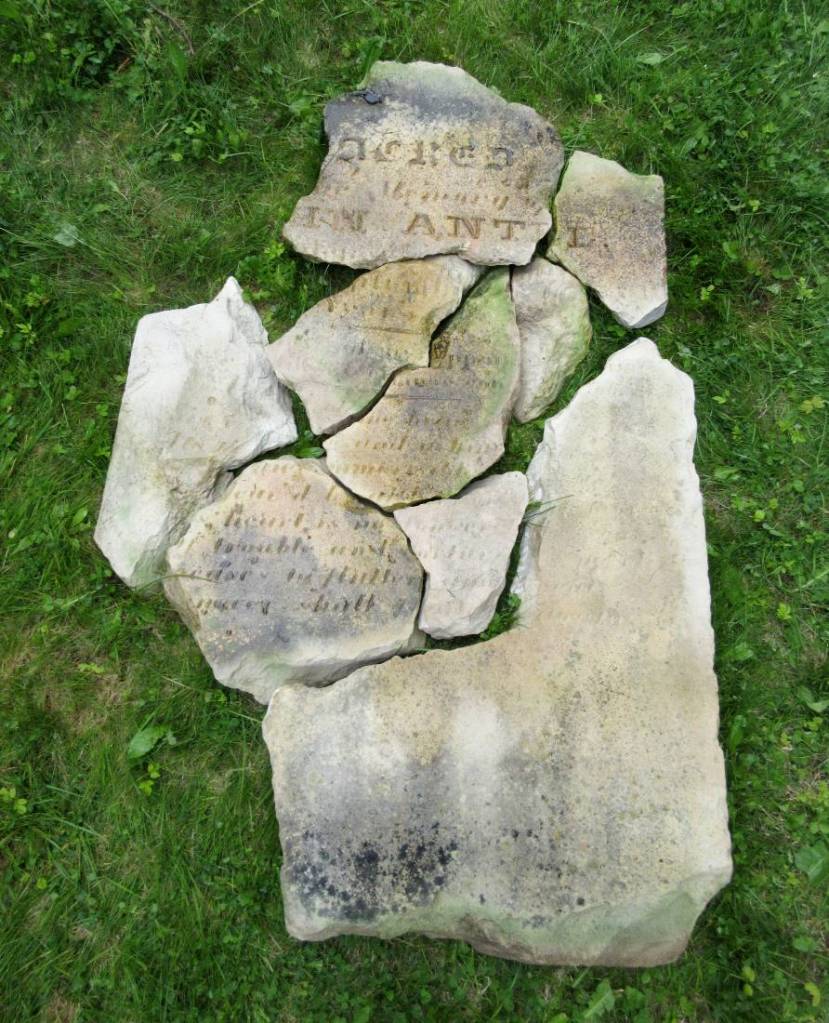
The completed Antle stone (photo by Lacy 2021)
Unfortunately, as as you can probably tell by the photos above, there is a great deal of stone missing from the Antle gravestone, and furthermore the edges of the remaining pieces are weathered and unstable in areas. This means that we had to make the difficult decision to leave the preservation process at the cleaning and transcription. This stone is in poor condition, with a highly weathered inscription, and is not in good enough shape to restore to standing. It would involve rebuilding massive areas of material that could negatively impact the stability of the existing stone, and would ultimately be detrimental in the long run. So for the mean time, the John Antle stone remains behind the museum.From what we could see on the weathered surface, Antle’s stone reads as follows:
[S]ACRED
[to] the Memory of
[JO]HN ANTLE
[Who] depart[ed] [this] [li]fe
[Se]ptemb[er] [?] 8 [l…?]
Years […]
We were really excited to undertake this project, and put together a gravestone that has been in pieces for years! If you are ever in Brigus, take a moment to visit the old Stone Barn Museum and the Brigus Blacksmith’s Shop, and take a peek behind the museum to visit John’s stone!

 Black Cat Cemetery Preservation