Welcome to the first of hopefully many fieldwork trip blog posts! The original plan was to make the trip on Friday before, June 11th, but of course the first fieldwork trip of the season couldn’t be that easy…and our car’s transmission decided to die the day we had planned to go. Instead, we called every mechanic in town, sputtered our car around, and ended up back at the house trying to figure out what was going on. It turned out that the transmission fluid had been leaking, but we got it all sorted out and were off to Bonavista only a few days later.
Our goal for this project was to clean the stone and take an inscription. It doesn’t sound like too difficult of a project, but when a stone has been sitting outside for a couple hundred years, the surface weathers and the inscription becomes very difficult to read. We drove out to Bonavista (stopping at Bare Mountain Coffee on the way, of course) and parked across the street from the Christ Church Anglican Cemetery, grabbed our supplies, and found the stone!
William Brown’s gravestone is made from limestone, which would have been imported from Ireland or England, as were many gravestones in Newfoundland during the 18th century. It really didn’t need much cleaning at all on the front, this stone and many other 18th-century gravestones at this site were in excellent condition! The back had more lichen on it, and we cleaned the entire stone with water and D/2 Biological Solution, using a combination of natural bristle and soft plastic bristle brushes. If you can see the orange on the face of the stone, that is the D/2 working to clean biological material from inside the pores of the stone, and will return to white as it dries!

Front face of Brown’s gravestone (photo by Lacy 2021) 
Back of Brown’s gravestone (photo by Lacy 2021)
Unfortunately, a lot of the inscription was difficult to read due to the heavy weathering to the face of the stone, but we believe that William died in 1768. This stone is in impressive condition for such an older date! The really difficult part was trying to figure out the poem below the body of the epitaph. It was popular to carve that part of an epitaph in italics which is extra hard to read when it is extremely weathered. We could only see bits and pieces of the poem, which we recorded, along with the last line, “Therefore prepare to die.”
Thankfully, twitter is full of amazing historians, folklorists, and archaeologists, so when I posted what we had of the poem after we got home, twitter made short work of it! The poem was a stanza recorded by John Bowden in his 1791 book titled ‘The Epitaph Writer‘, and comes from a large monument in Chester, England. It can be found on page 22, and I’ve included a screenshot below. It was really exciting to see that the archaic ‘s’ was used on the gravestone as well!
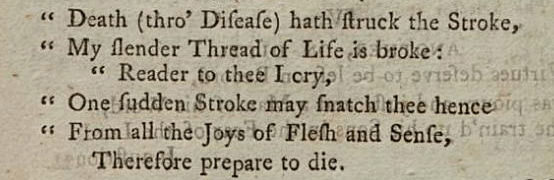
It was wonderful to be able to travel to Bonavista to be able to clean and record this gravestone, and we hope to be doing much more of this work in the future! It’s so vital to recognise that these historic sites, cemeteries, and gravestones, are part of our history and are public heritage resources within their communities. They deserve to be protected and revitalised!
Stay tuned to our blog for updates on other project we have been working on, and please send us an email (blackcatpreservation@gmail.com), or reach out on facebook or instagram (linked in the sidebar) if you have a historic gravestone project that we might be able to help you with! Thanks for reading!


 Black Cat Cemetery Preservation
Very interesting! My great great grandparent’s stone at Ppu d Cove is getting harder and harder to read and I’d love to know what I might do to help it. What is the cleaning solution you mentioned/where would I get that?
LikeLike
Hi Janet, sorry we didn’t see your comment until just now! The cleaning solution we use is called D/2 Biological Solutions, and you can order it from a few companies in Canada: Derusha Supply and Sage Restoration are our go-tos!
LikeLike
Pound Cove!
LikeLike
I’m a 6th generation descendant of this Wm. Brown, so it is ice to read your blog on the work you did. I have other info for him via another descendant who I think commissioned the project. One question what was used to preserve it now?
LikeLike
Hi there! Thanks so much 🙂 To preserve the stone today, it has been cleaned with D/2 which will keep it clean from lichen growth for several years. It is in a churchyard that is regularly maintained, so he’s in good hands!
LikeLike