Hello friends, it has been a long time since I’ve updated our fieldwork blog! In that time I (Robyn) have finished my PhD, and our co-director Ian is in the throws of writing his PhD dissertation. We’re nearly there, folks! We just started our 2025 field season two weeks ago, as the weather has finally warmed up a little here in Newfoundland, and we have been busy beavers scuttling around the cemeteries, working on some gravestones for families who have entrusted their headstones to our care (thank you!).
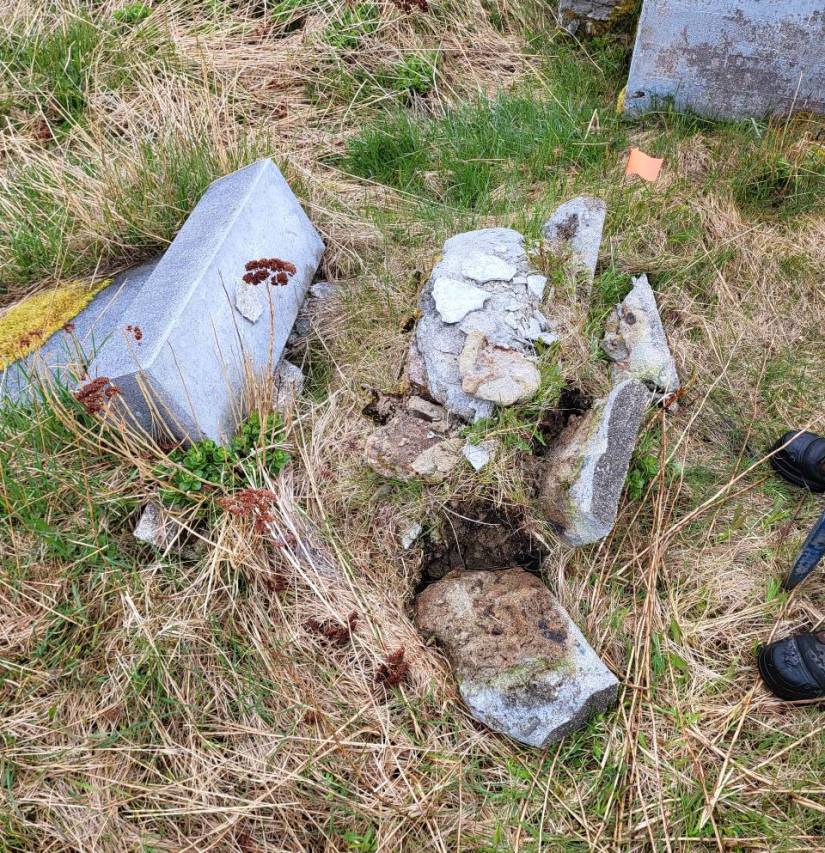
A lot of the repair work we end up doing across the province is removing material from failed old repairs and seeing how we can fix and improve the situation. There is a lot of old, out of date information floating around about what kind of materials are safe to use for historic stone repair (not only on gravestones, but on walls and buildings too!), and one of our goals at Black Cat is to spread as much knowledge of up-to-date, no-harm conservation for stones as we can. We totally understand and appreciate that people are out there, caring for their families headstones with whatever supplies and knowledge they have, and it’s wonderful to see! And if we can help you change your techniques a little so those stones last for even more generations to come, then we’ll be doing a good job in the province.
With that, I’d like to make my annual PSA to the internet about stone conservation:
Please do Not use concrete / Portland cement on historic stones!!
I cannot stress that enough. Please put down the concrete mix. Lets go over the reasons why:
- Concrete is extremely difficult to remove from soft stones. Marbles, sandstones, and limestones, make up the majority of historic gravestones in the province and they are very soft. Concrete is not. If the repair fails, it is extremely difficult or impossible to remove that concrete from the stone to fix it again.
- Concrete is not permeable. Bear with me and my fancy words. Concrete does not breathe or let water through. When you stick the bottom of a gravestone in concrete, or lay the entire stone into a slab of concrete like is very popular in parts of Ontario (please don’t adopt that practice), water can no longer leave the stone in those areas. It will cause the stone to soften and either break at that point which is now weakened, or weather away if the entire back of the stone is set into concrete. The same thing happens with walls of stone or brick, when the pointing between the bricks is done with concrete…the water has no where to go, so it goes out the brick, eventually taking the brick with it. The way historic buildings counteract that is that they were built with lime mortar, which is moisture-wicking, drawing moisture out of the material around them. Eventually the mortar breaks down and has to be replaces, but not the wall itself.
Those are the two main reasons not to use concrete: It’s not removable, and it causes the stone to break down faster. Using it will not help your gravestone, only speed up its eventual destruction, and unfortunately there is nothing we can do about that.
There is one instance where we use concrete in our conservation work, and that is making new bases for gravestones. Not setting the stone directly into wet concrete, but making a base with a slot that will fit the stone running through. Once fully cured, we set that base into the ground, and secure the gravestone into the slot using lime mortar. Again, the mortar will wick moisture away from the stone while also holding it in place and upright, improve the lifespan of the gravestone!
I hope this little post was helpful to you! If you need help with your family’s gravestones, or know a heritage group that might need our help, feel free to email!

 Black Cat Cemetery Preservation
1 thought on “Gravestone Cleaning & Repair PSA”