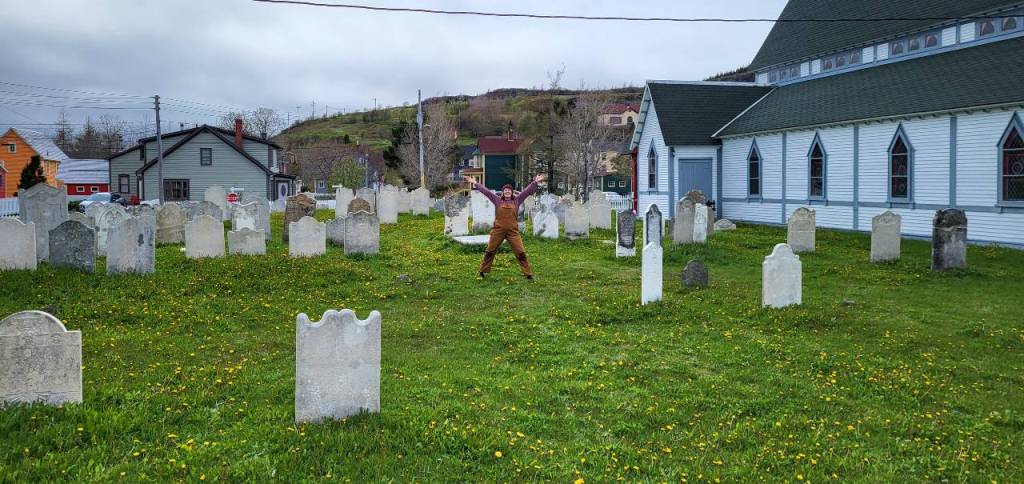
After five weeks on site, our project at the St. Paul’s Anglican Churchyard in Trinity, NL, has come to an end. We’ve had an absolutely amazing time working with the Trinity Historical Society, and would like to extend a huge thank you to Trinity Cabins, who put us up for the duration of the project, and to everyone who donated to the Adopt-A-Headstone fundraiser! We couldn’t have done this huge project without you!
We completed the last few days of gravestone cleaning earlier in June, where we had about 38 gravestones left to clean over the course of two days. When we arrived back at our beloved cabin, Trio, the weather was a little cooler than we’d have liked, but luckily we didn’t have to worry about epoxy like we did in Greenspond the week before (keep an eye out for that blog post soon!). We only brought our D2, water sprayers, and cleaning brushes with us for this last hurrah to restore the churchyard, as well as a conservation-safe adhesive called Paraloid B72, to inject into the delaminating pieces of several gravestones that weren’t in the best shape.
B72 comes in a pellet form, and you have to dissolve it into acetone over several weeks before it is in a useable form. As we’d never used the product before, we consulted a local conservator on the ratio to use, and how best to prepare it to the viscosity that we needed for the project. After injected, the project will start to set and the acetone will eventually evaporate, leaving the adhesive securing the crack or material together. That way, it can also be removed by acetone if needed in the long run, which is what makes it a great adhesive for conservation. You can see Ian injecting the adhesive in the photo below!


The majority of the work we did at the end of this project was cleaning, and you can see Ian above, with a handheld pump-sprayer, spraying a gravestone with water to rinse the suds of the D2 from the stone. D2 continues to work over the course of several weeks to lighten the stone by cleaning out lichen and some environmental staining caused by acid rain (the grey stains!). The hardest stone to clean was one sandstone marker, which was covered in at least 5mm of lichen! We filmed a little video of the cleaning process, which took over two hrs, and included using bamboo skewers to clear the lichen growth out of every letter on the stone’s face. It turned from grey to a warm brown! You can head over to our Instagram @blackcatpreservation to view that, and some other videos and photos if you’re interested in more information on this phase of the project.
And with the cleaning of the last 38 gravestones, we were finished! I (Robyn) had first started discussing this project with Ian Morris and Kevin Toope of the Trinity Historical Society several years ago, and the fundraising and planning started officially in 2021. It has been an amazing two seasons, and we hope that everyone who visits Trinity in the future have as magical of a time in the town and the churchyard as we have. It’s truly a special place!


 Black Cat Cemetery Preservation