Long time no see, reader! For archaeologists, the winter is basically a time for hibernation and resting our weary bones from digging and moving heavy stones around all summer. We may be resting (and working on our PhD programs) but we’re also thinking about the upcoming field season and how much fun we had last year! Today I wanted to share with you the story of Jane Condon’s grave in New Perlican, overlooking Vitters Cove, and discuss why painting gravestones is detrimental to their conservation.
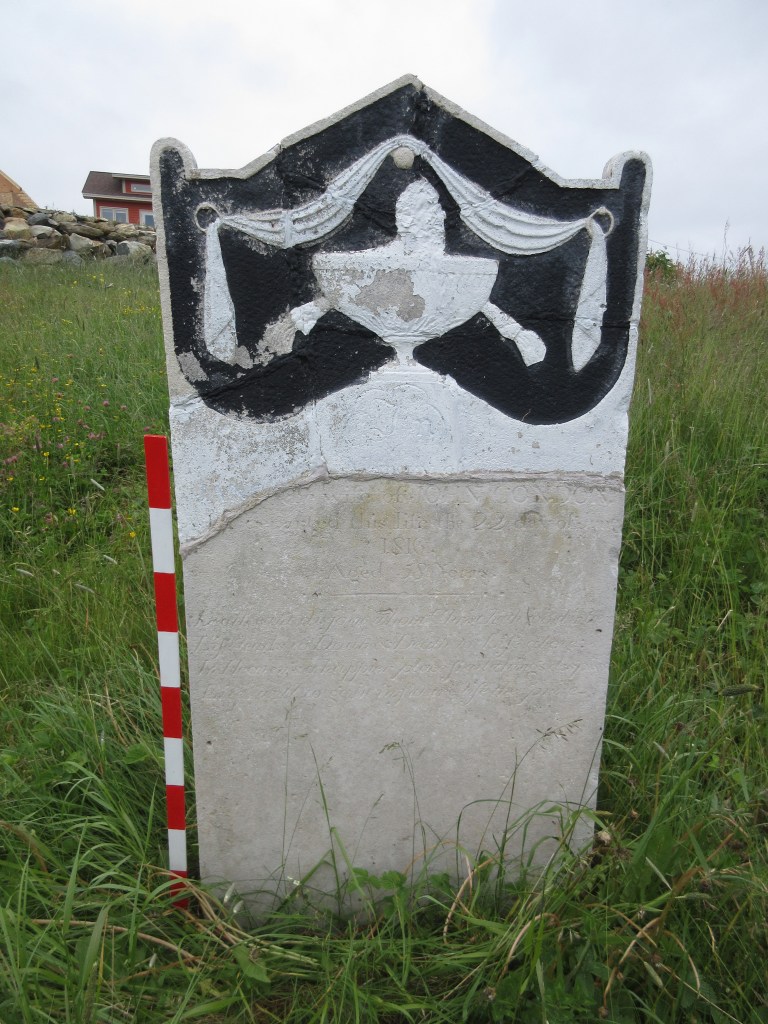
Jane Condon’s gravestone overlooks Vitters Cove from the western shore, near a portion of the D’iberville Trail which follows the coastline around the peninsula in the community. Designated as a municipal heritage site in 2014, the site consists of one limestone headstone (Jane’s) and two small fieldstones marking additional graves. It is possible that there are other burials in the area, and is likely that the graves comprise a small family burial ground, as was common in outport communities in Newfoundland before consecrated grounds and/or organised community burial grounds were established.
We were contacted by Heritage New Perlican, the local heritage associate, to clean Jane’s gravestone and to try and remove as much of the paint that covers a portion of the surface as possible. This gravestone met an unfortunate fate a number of years ago, after the broken top portions of the stone were taken from the site, glued back together, and painted. While the person who carried out these modifications did so with the best intentions at heart, today we know that irreversible treatments like certain glues, and painting a gravestone, are techniques that we want to avoid because of the damage that they can cause. Unfortunately, paint is extremely difficult to remove from historic stones as there are no paint strippers that are safe to use on historic stone…in other words they would cause damage while removing the paint, which is the opposite of what we strive to do through our preservation practice.
While there was nothing we could do about the putty-coloured adhesive, which is still very much doing its job holding the stone together, we used soft wood dowels, water, and D/2 Biological solutions to soften and remove as much of the paint as we could. Paint gets stuck in the pores of the stone, and a material like limestone is quite porous, making the paint even more difficult to remove. Additionally, painting a gravestone causes moisture in the stone to be trapped inside, rather than seeping out through the stone’s face. This means that the stone will weather faster, and in turn fall apart faster. Even when a stone is hard to read, leaving it unpainted means it will be around even longer for others to enjoy.

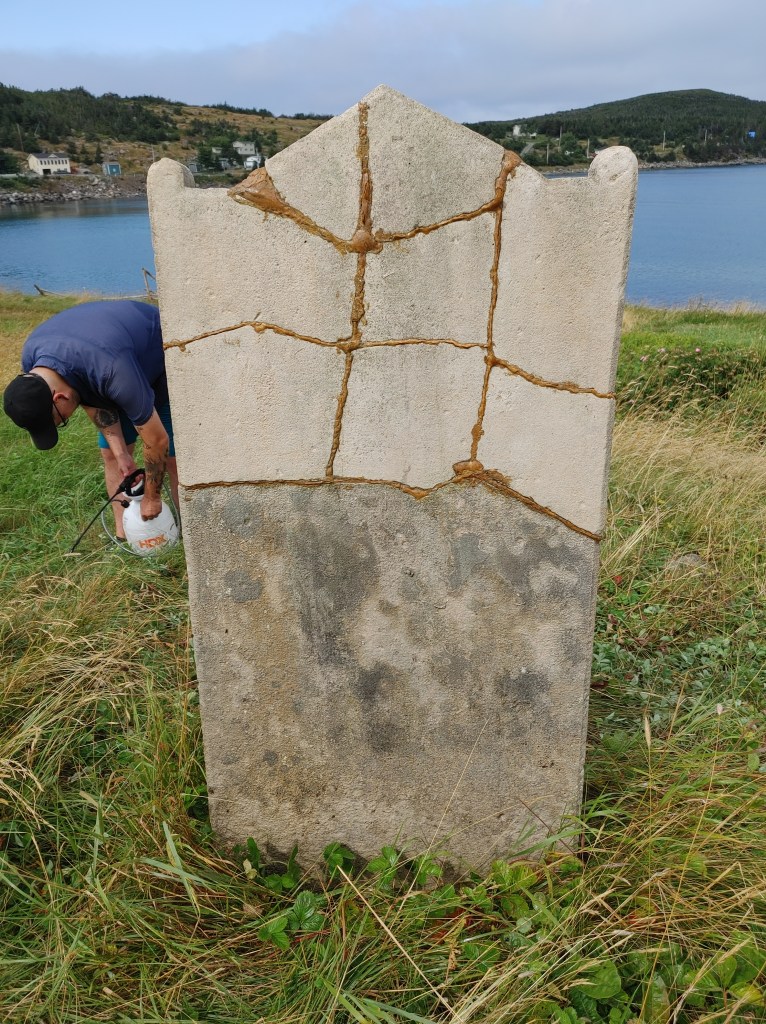
As you can see in the above photos, there was not a lot we could do unfortunately. While some of the paint did come off, and we were able to provide protection in the form of D/2 against future lichen and moss growth, of which there was a substantial amount around the base of the stone (along with a lot of snails who were probably there for the calcium). However, projects like these are still very worthwhile in my opinion, as by removing loose paint on the face of the gravestone, we were able to expose additional edges of the paint that can speed up the weathering of the rest of the paint.
Jane Condon’s gravestone reads:
IN
Memory of
JANE the wife of JOHN CONDON
who departed this life the 22nd day of June
1816.
Aged 58 Years.
.._________..
Death [can’t] disjoin whom Christ hath joined in love
Life leads to Death & Death to Life alone:
In Heaven [is] a happier place [d_____]
Live well to gain in future life the [prize].
Thank you to Heritage New Perlican for involving us in this project, and in the continued care of Jane Condon’s grave. I cannot think of a better view to have for your burial.

 Black Cat Cemetery Preservation